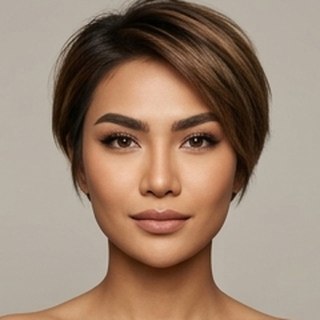
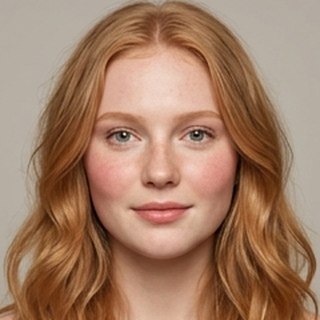
MyType FYI · Visual attraction testWhich face is actually your type?

Everyone has a physical type — almost nobody can put it into words. Tap the AI-generated faces that catch your eye and the MyType FYI model maps your exact bone-structure taste, your hidden gems and your personal top 2% in real time.

  • No sign-upStart tapping instantly
  • ~2 minutes6–10 crowds of 12 faces
  • PrivateNothing leaves your browser
Round 1 / 10 0 picked

Tap every face you find attractive.

01Archive

What real MyType FYI result cards look like

Why did the MyType FYI quiz explode across X (Twitter), TikTok, and Reddit? Because seeing someone’s Hotties You Like next to their Hidden Gems (Mids You Love) and Popular Faces Not Your Type exposes the invisible architecture of human attraction. Cycle through real anonymized rating sessions below to see how dramatically individual taste diverges.

Anonymized MyType FYI profile · a rater from New York City, New York
20 crowds · 240 AI faces evaluated · revealed preference vector

Their favorites

Lion · Tortured artist · Long hair

Overlooked gems they love

High cheekbones · Warm smile

Popular, not their type

Buzzcut · Finance bro · Older man

02Method

The science behind the MyType FYI test: why words fail and rapid face taps succeed

If you ask someone to describe their ideal partner on a traditional my type quiz, they will recite broad demographic clichés: “tall, dark hair, kind smile” or “blonde girl next door.” Yet when that same person swipes through faces on a dating app or walks into a crowded room, their eyes lock onto a hyper-specific combination of craniofacial geometry in less than a tenth of a second. Here is how the MyType FYI methodology decodes that hidden signal.

Stated preferences vs. revealed preferences in human attraction

In behavioral economics and evolutionary psychology, researchers draw a sharp boundary between stated preferences (what you consciously believe and tell others you want) and revealed preferences (what your micro-decisions actually select when presented with real visual stimuli). Most online my type test questionnaires fail because human language was never designed to parameterize a human face.

You cannot easily write down the exact millimeter ratio between a cheekbone prominence and a mandibular angle, the subtle slant of a medial canthus, or the way a straight Greek nose bridge meets a heavy brow ridge. However, your visual cortex processes those exact structural vectors effortlessly. By replacing verbal questions with rapid 12-face contact sheets, the MyType FYI test bypasses conscious rationalization and records your raw perceptual attraction.

100-millisecond “thin-slice” facial perception

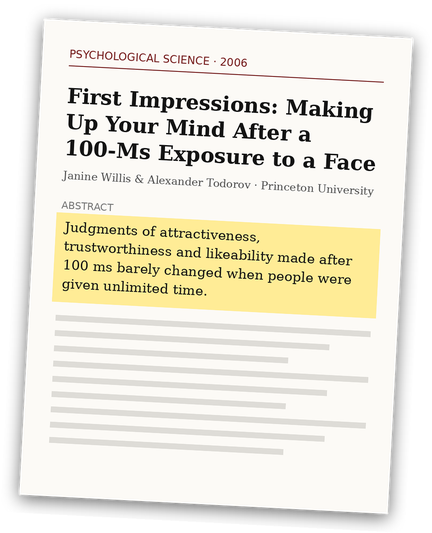
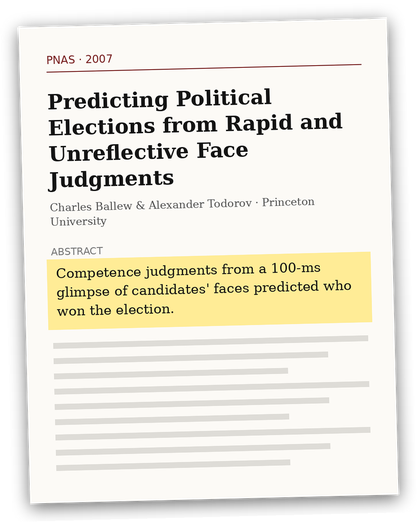
Why can you tap through a 12-face crowd on MyType FYI in just a few seconds and still produce a highly stable statistical model? Because human facial evaluation is astonishingly fast and consistent over time. In a landmark study published in Psychological Science (Willis & Todorov, 2006), researchers demonstrated that a 100-millisecond exposure (one-tenth of a second) to a stranger’s face yields nearly the exact same attractiveness and trait judgments as unlimited viewing time.

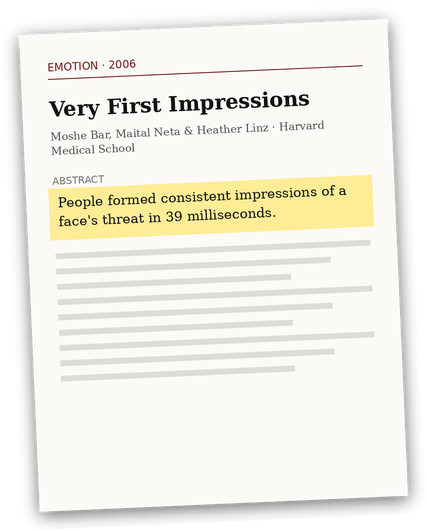
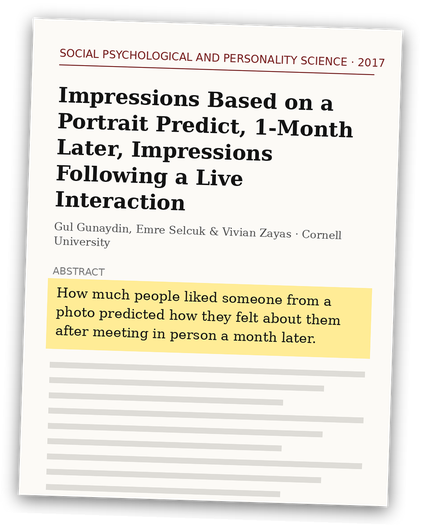
Follow-up studies in Emotion (Bar, Neta & Linz, 2006), PNAS (Ballew & Todorov, 2007), and Social Psychological and Personality Science (Gunaydin, Selcuk & Zayas, 2017) confirmed that split-second evaluations made from a still photograph still predicted how much participants liked that person after meeting them face-to-face a full month later. Because rapid visual attraction is both immediate and durable, the MyType FYI tap-and-replace interface captures high-signal psychometric data without fatigue.

Willis and Todorov Psychological Science 2006 paper on first impressions from facial appearance Bar Neta and Linz Emotion 2006 study on very first impressions Gunaydin Selcuk and Zayas 2017 study on photograph attraction predicting live interaction Ballew and Todorov PNAS 2007 study on rapid facial judgment accuracy

Primary literature: Willis & Todorov (Psychological Science, 2006) · Bar, Neta & Linz (Emotion, 2006) · Gunaydin, Selcuk & Zayas (SPPS, 2017) · Ballew & Todorov (PNAS, 2007).

Adaptive Bayesian crowd sampling & out-of-sample accuracy

When you take the MyType FYI quiz, the 12-face grids are not random static pages. Behind the scenes, every synthetic portrait in the catalog is embedded across dozens of continuous latent dimensions—spanning craniofacial bone structure (jaw width, chin projection, nasal bridge contour, brow thickness), eye geometry (hunter eyes vs. doe eyes, scleral show), skin tone, hair texture, and styling vibe.

During your first four crowds on MyType FYI, the sampler maximizes diversity to establish your baseline across the entire facial manifold. From Crowd 5 onward, the algorithm shifts into active learning: each new 12-face crowd mixes high-probability faces that your current vector predicts you will love alongside “boundary-testing” faces that probe the exact edges of your type. Before you tap a single portrait in a new crowd, the model ranks all twelve faces from 1st to 12th. Afterward, it measures how often a face you tapped was ranked higher than a face you skipped—reporting your real-time out-of-sample ROC-AUC accuracy (where 50% is a random coin toss and 85%+ indicates a tightly converged personal aesthetic model).


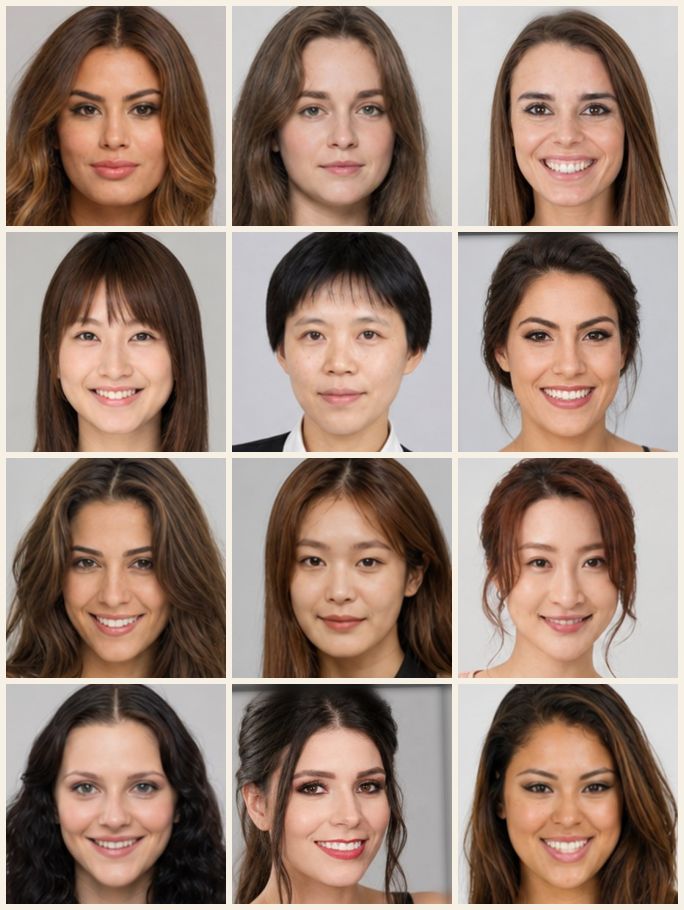
A 12-face AI crowd grid from the MyType FYI visual attraction test
Fig. 1 — The 12-face contact sheetEvery face in a MyType FYI crowd is 100% AI-generated and screened to depict a fictional adult. Tapping a face logs a positive preference and immediately refills the slot.
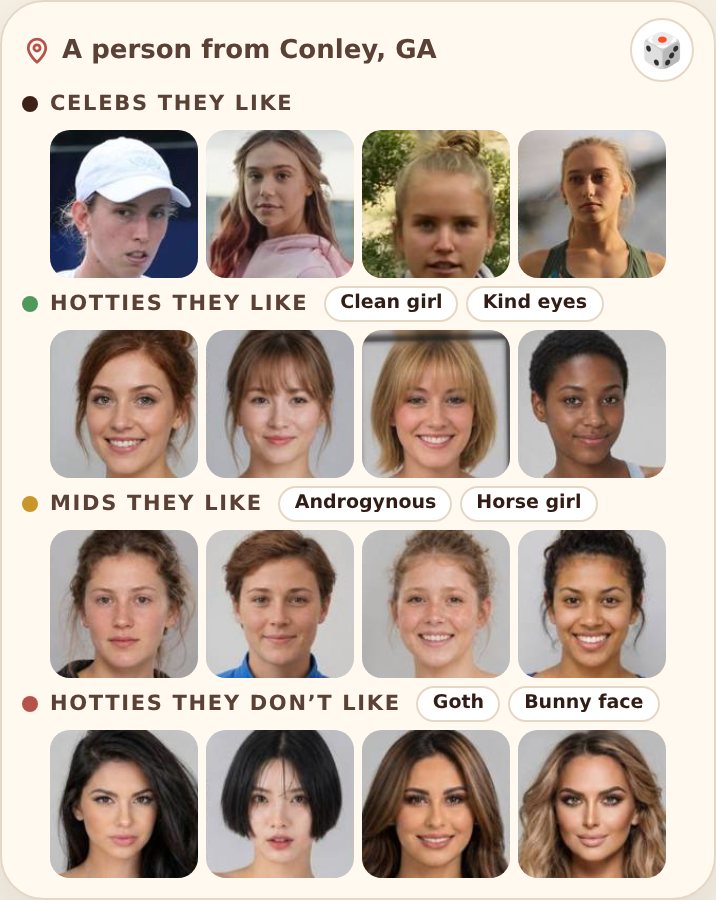
Example MyType FYI result card showing Hotties You Like, Mids You Like, and trait pills
Fig. 2 — The diagnostic cardInstead of reducing attraction to a single 1-to-10 number, the MyType FYI report separates consensus attractiveness from idiosyncratic personal taste.
100msis all it takes your brain to form a stable attraction judgment.
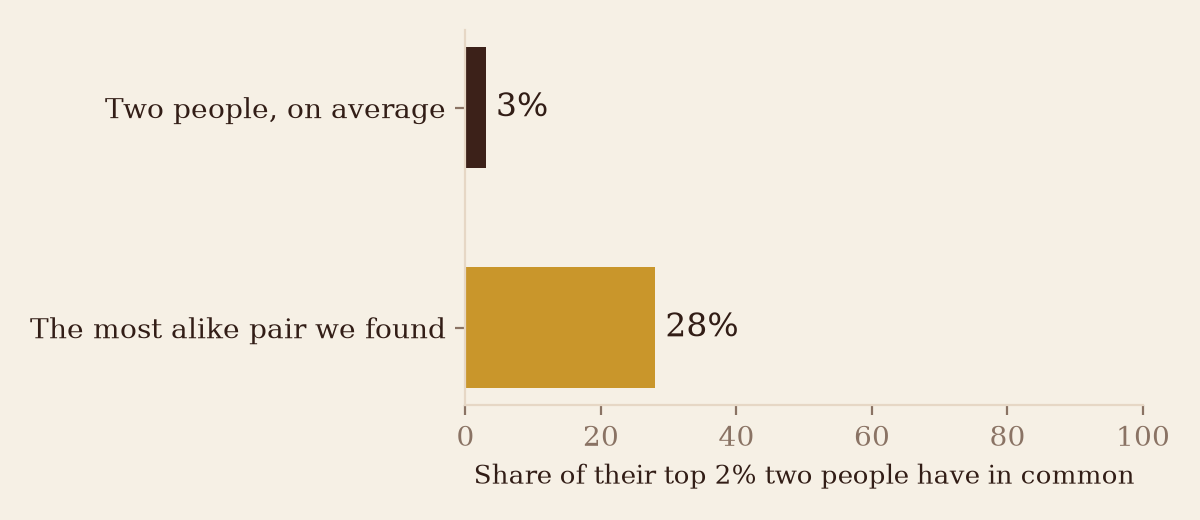
3%average overlap between two people’s personal top-2% faces.
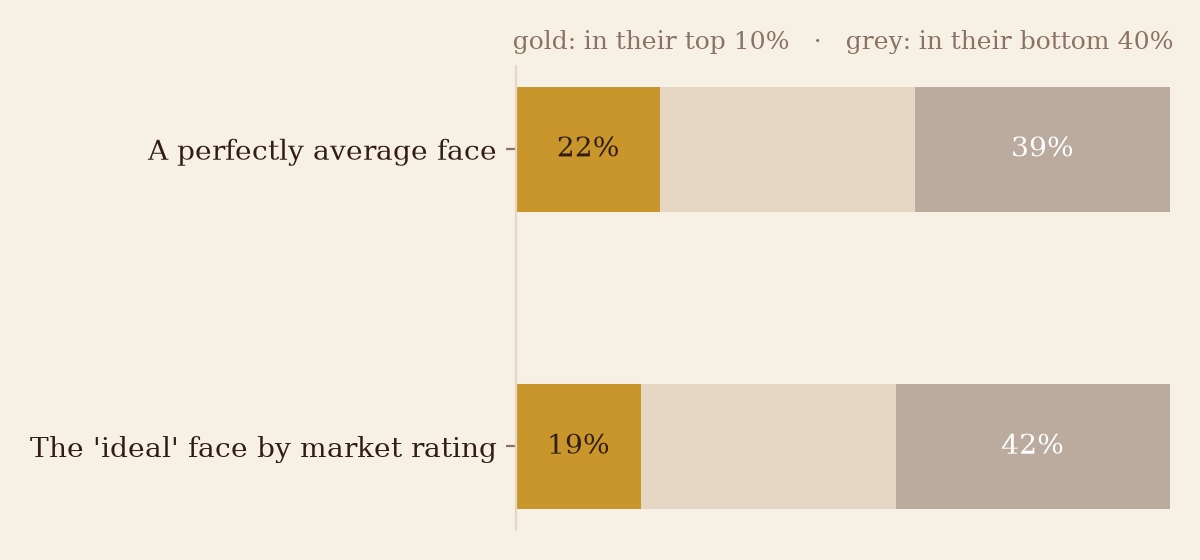
19%of raters put even the #1 most popular face in their top 10%.
42%of raters put that same face in their bottom 40%.
03The Data

The “3% overlap” discovery: why everyone is chasing the wrong faces

One of the most common myths on the internet is that 90% of people are competing for the exact same top 5% of “objectively attractive” faces. Large-scale data collected through the MyType FYI attraction test proves the exact opposite: human visual taste—especially when rating women, and to a surprising degree when rating men—is vastly more idiosyncratic than anyone realizes.

3%

Average top-2% overlap: take any two people who rate the same pool of faces on MyType FYI and compare the portraits in each person’s personal top 2%. On average, two raters share only 3% of their top picks. Even the single most similar pair of raters in the dataset shared just 28%.

Why “objective 10s” split the room

If attractiveness were a single universal ladder, the highest-rated face in the MyType FYI catalog would land in almost everyone’s top tier. Instead, empirical distributions show that even the #1 highest-consensus face in the entire dataset lands in the top 10% for only 19% of raters, while falling into the bottom 40% for 42% of raters. Meanwhile, a face with a dead-average 50th-percentile market score still lands in the top 10% for roughly one in five people.

There is an interesting gender asymmetry in the MyType FYI data as well: raters evaluating men’s faces exhibit higher consensus (sharing roughly 43% overlap in broad attractiveness tiers), whereas raters evaluating women’s faces diverge dramatically across facial archetypes, bone structures, and styling vibes.

The 2% Moneyball principle (“diamonds within reach”)

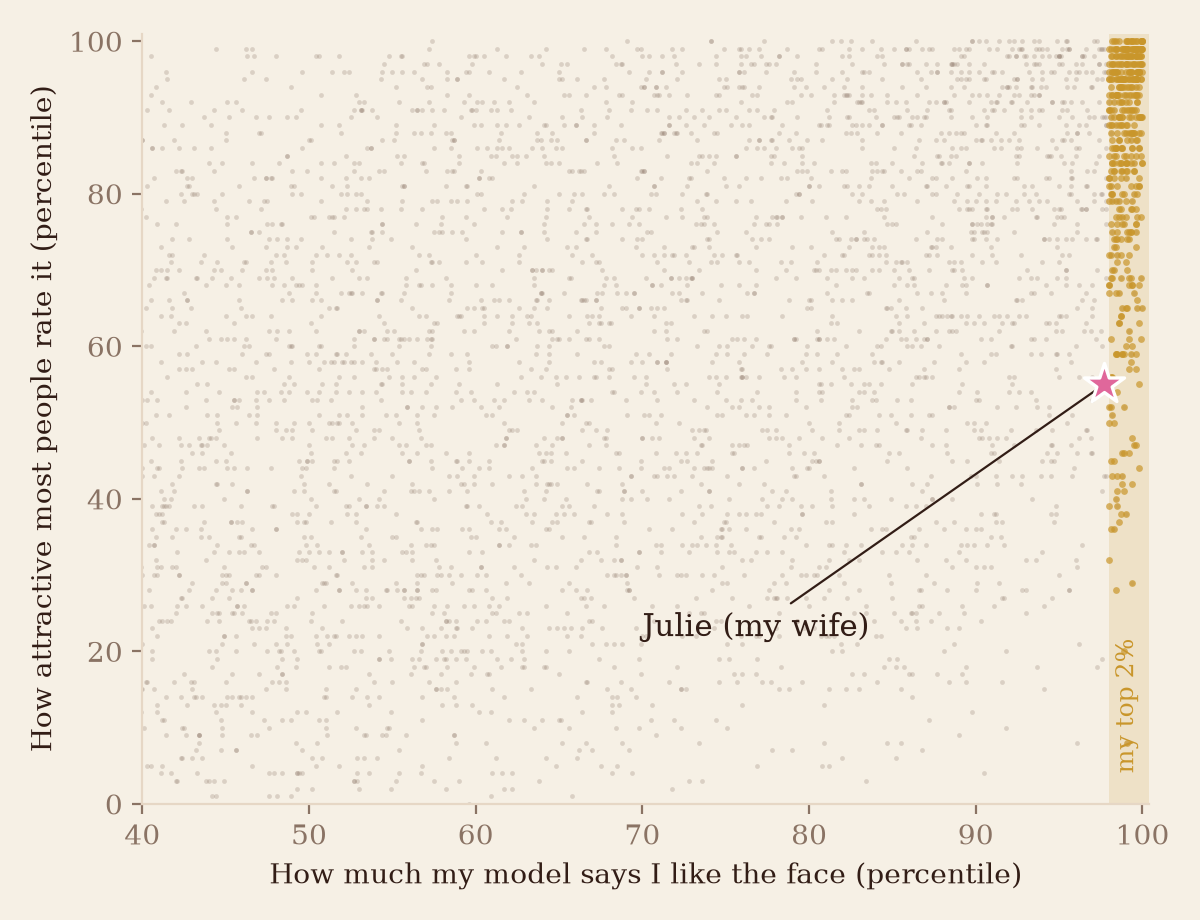
When AI researcher Matthew Fisher built the original MyType FYI model and tested where his own wife, Julie, landed on his preference chart, he uncovered a striking pattern (Fig. 5). On his personal MyType FYI axis (left to right), Julie sat at the 98th percentile—right inside his personal top 2%. Yet on the general crowd-consensus axis (bottom to top), other raters placed her face near the 55th percentile, right in the middle of the market.


In the book Moneyball, a small-market baseball team beat the richest franchises in sports by identifying undervalued players whose on-base statistics translated to wins, even though traditional scouts overlooked them. Dating suffers from the exact same market inefficiency. On conventional swipe apps, millions of users exhaust themselves competing for a tiny handful of 95th-percentile consensus “hotties,” while completely overlooking the 55th-percentile hidden gems (“mids you love”) who are a 98th-percentile match for their personal MyType FYI vector.

When you add the requirement that attraction must be mutual, the math becomes even clearer: if two people are each inside the other’s personal top 1%, that is a 1-in-10,000 coincidence by random street encounters—requiring roughly 24 years of five-minute speed dates to stumble upon by chance. Understanding your type via a visual preference test turns dating from a status competition into a targeted search for mutual hidden gems.

MyType FYI chart showing two people share only 3% of their top 2% faces on average
Fig. 3 — Top-2% overlapTwo raters on MyType FYI share only 3% of their top-2% favorite faces on average.
Chart showing how the same face is rated across different percentiles by different people
Fig. 4 — Consensus splitsEven the highest-rated face in the MyType FYI pool lands in the bottom 40% for 42% of people.
Scatter plot showing personal Top 2% gold band versus general market percentile
Fig. 5 — The Moneyball bandEvery dot is a face. Left-to-right is personal MyType FYI score; bottom-to-top is crowd consensus. The gold band is the personal top 2%.
Chart comparing two raters top 2% breakdown across ethnic backgrounds
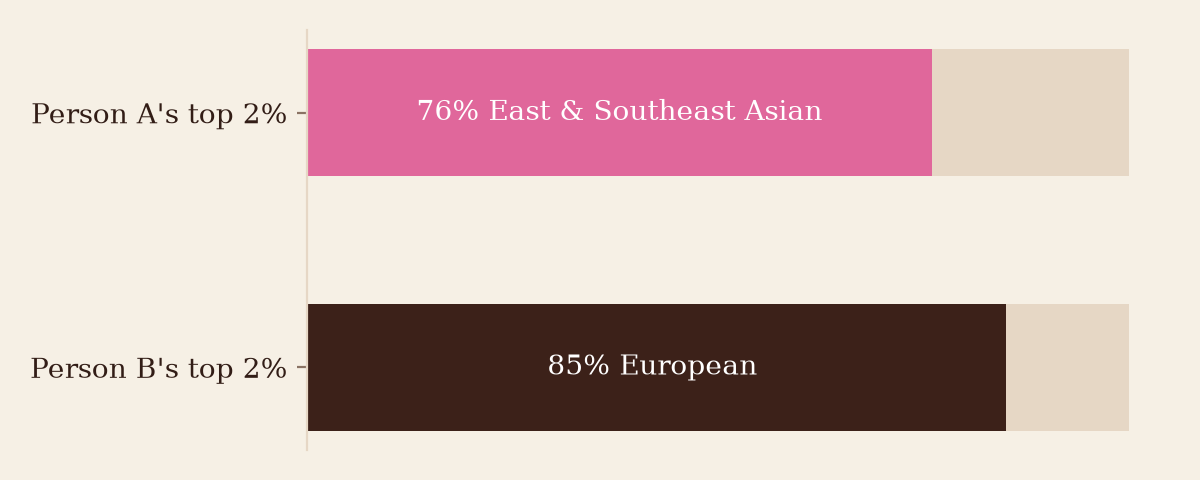
Fig. 6 — Taste across heritageRaters consistently favor their top bone-structure matches across every background rather than following a single market norm.
04Archetypes

Why “Greek nose” exploded on Google Trends — and the 77 archetypes in the MyType FYI catalog

When the MyType FYI test went viral, one unexpected search term surged alongside mytype fyi, my type fyi, mytype.fyi, mytypefyi, mytype test, mytype quiz, and my type quiz: “Greek nose.” Here is why specific bone-structure labels on MyType FYI result cards resonated with millions of users—and how to explore all 77 documented facial types in the MyType FYI directory.

What is a “Greek nose” on a MyType FYI result card?

In classical anthropometry and aesthetic portraiture, a Greek nose (also referred to as a straight classical nasal profile) is defined by a remarkably straight nasal dorsum descending from the nasion (the bridge between the eyebrows) to the nasal tip without a pronounced dorsal hump or deep nasal scoop. Unlike a button or upturned celestial nose, a Greek nose creates strong vertical midface architecture and a sculptural side profile that stands out immediately in a MyType FYI 12-face crowd.

Why did so many people discover a preference for the Greek nose only after taking the MyType FYI quiz? Because modern social media filters artificially shrink and flatten noses toward a single homogenized neotenous template. When users tapped through unfiltered, diverse AI-generated bone structures on MyType FYI, thousands realized that their highest-rated faces—especially within the Greek Nose & Classical Profile, Mediterranean Look, Big or Strong Nose (Men), and Prominent Character Nose (Women) clusters—shared strong, character-rich nasal bridges paired with expressive dark brows.

Other high-signal traits mapped by the MyType FYI quiz

  • Hunter eyes vs. big doe eyes in MyType FYI: low, straight brow ridges with minimal upper-eyelid exposure and a positive canthal tilt (Strong Jaw & Chiseled) versus wide, warm, rounded almond eyes (Big Doe Eyes and Kind Eyes).
  • Smooth pretty boy vs. rugged lumberjack in MyType FYI: high-harmony, clean-shaven neotenous features with soft hair (Smooth Pretty Boy) versus heavy mandibular width, thick facial hair, and weathered masculinity (Rugged Lumberjack & Well-Kept Beard).
  • Tortured artist & goth / alt aesthetics in MyType FYI: high-contrast pale complexions, dark circles, and moody styling (Pale, Tired, Fragile Look, Goth / Emo / Alt Guy, and Goth Girl) that score below 40% in the mainstream market yet hit 99% on a niche rater’s MyType FYI card.
Greek nose portrait example 1Greek nose portrait example 2Greek nose portrait example 3Greek nose portrait example 4
Trending #1 trait

The Greek nose & classical profile

A straight dorsal bridge, minimal nasofrontal depression, defined cheekbones and intense brow framing. Frequently co-occurs with Mediterranean, Levantine and classical European bone structures in MyType FYI models.

Popular types in the MyType FYI directory

View all 77 types
05Compare

How this no-login MyType FYI web app compares

Whether you want an instant 90-second visual readout with zero email gates or a deep 20-crowd statistical exploration, here is how our browser-native MyType FYI test compares to account-locked platforms and older text-based personality quizzes.

This siteMyType FYI instant web appAccount-gated face testsText “my type” quizzes
Sign-up / email loginNone — first tap starts it, 100% anonymousGoogle OAuth, X login, or email magic linkOften gates results behind email capture
Time to result card~90 seconds (6–10 crowds) + one-click unlock10 to 15 minutes (20+ crowds minimum)3 to 5 minutes of multiple-choice reading
Measurement methodRevealed preference via 12-face AI contact sheetsRevealed preference via 12-face AI crowdsStated preference (self-reported clichés)
Moneyball matrix & scatter plotFull 4-row matrix + live 2D mapIncluded after account verificationNot available (generic paragraph)
Crush / partner photo checkFree, 100% on-device, zero uploadPaid add-on ($10–$25) or geo-restrictedNot available
9:16 story card exportInstant high-DPI PNG with your picked facesRequires account session linkText screenshot only
06FAQ

Everything you need to know about the MyType FYI attraction test

Detailed answers on how the MyType FYI test calculates your physical type, why specific craniofacial traits like the Greek nose appear on result cards, and how your privacy is protected.

What is the MyType FYI test and why is it trending everywhere?

The MyType FYI test (often searched as mytype.fyi, my type fyi, mytype test, or mytype quiz) is a viral visual attraction assessment that maps your subconscious physical preferences without asking a single text question. Instead of checking boxes for height or hair color, you tap the faces that catch your eye in 12-portrait AI crowds. Within a few rounds, the MyType FYI statistical model identifies the exact bone structures, eye shapes, nasal profiles (such as the viral Greek nose), and aesthetic archetypes you naturally gravitate toward—along with your 'Hidden Gems' (faces overlooked by the crowd that sit in your personal Top 2%).

Do I need an email, Google account, or X login to take this MyType FYI quiz?

No. While the original account-gated version of mytype.fyi requires an email magic link or Google/X OAuth login before saving your crowds, this MyType FYI workspace runs 100% in your browser with zero sign-up required. You can tap faces immediately on the first screen, view your live You-vs-Everyone Moneyball scatter plot after every tap, unlock your full diagnostic card in 6 to 10 rounds, and download a high-resolution 9:16 PNG story card completely anonymously.

Why is 'Greek nose' trending alongside MyType FYI searches?

Thousands of users sharing their MyType FYI result cards on X (Twitter), TikTok, and Reddit discovered that their top positive trait pill was 'Greek nose', 'Roman nose', or 'Big strong nose'. Because most people cannot articulate craniofacial anatomy in everyday conversation, seeing 'Greek nose' on their MyType FYI readout triggered a massive wave of searches from people looking up what a classical Greek nasal profile looks like (a straight, unbroken bridge descending from the nasion with minimal dorsal hump).

What do 'Hotties You Like', 'Mids You Love (Hidden Gems)', and 'Hotties You Skip' mean?

Every AI-generated portrait in the MyType FYI pool has a baseline 'Crowd Consensus Percentile' (how often everyone else taps that face) and a 'Personal Type Score' (how strongly your individual model predicts you will tap it). 'Hotties You Like' are high-consensus faces (top 30% of the market) that you also love. 'Hotties You Skip' are universally popular faces that leave you completely cold—revealing where your taste diverges from the crowd. 'Mids You Love' (or Hidden Gems) are faces rated around the 35th to 60th percentile by the general public that score in the 95th to 99th percentile for your specific MyType FYI vector.

How does the 2% Overlap ('Moneyball Mutual Attraction') principle work?

Empirical analysis of MyType FYI rating sessions shows that when two people evaluate the exact same pool of faces, their personal Top 2% favorites overlap by only 3% on average (and at most 28% for the most similar pair). Even the single highest-rated face in the entire dataset lands in the Top 10% for only 19% of raters and falls into the bottom 40% for 42% of raters. Just like Moneyball in baseball, modern dating is inefficient when everyone competes for the same consensus faces while ignoring the 'undervalued' faces that sit right inside their personal Top 2%.

Why am I attracted to people who aren't what I say my type is?

Psychologists distinguish between 'stated preferences' (what you claim in words when someone asks 'what is my type?') and 'revealed preferences' (what your visual cortex responds to in 100 milliseconds). Landmark studies by Willis & Todorov (2006) and Gunaydin et al. (2017) proved that human observers form stable attraction judgments within a tenth of a second based on subtle geometric ratios—jawline gonial angle, brow ridge prominence, interpupillary distance, and smile warmth. Because the MyType FYI test (often searched as my type fyi, mytypefyi, or mytype test) learns strictly from your rapid taps rather than verbal self-reports, the MyType FYI model uncovers the hidden patterns behind attractions that surprise you.

Are the faces in the MyType FYI test real people?

No. Every portrait in the 12-face MyType FYI crowds is a 100% synthetic, AI-generated adult face created specifically for visual preference modeling. No real person is ever rated or ranked in the MyType FYI crowds, and you never need to upload a photo of yourself to take the mytype quiz and discover your type.

How does the Local Crush / Partner Compatibility Check on MyType FYI work?

Once your MyType FYI preference vector is calibrated, you can optionally test any portrait using the browser-only Compatibility Checker inside your MyType FYI report card. The image is analyzed entirely inside your device's HTML5 Canvas memory (zero bytes are ever transmitted to a server) to estimate how closely its visual contrast and proportion profile aligns with your MyType FYI Top 2% Moneyball zone.

What is the difference between mytype.fyi, mytypefyi, and a traditional my type test?

The viral mytype.fyi experiment (also searched as my type fyi, mytypefyi, mytype test, or my type quiz) introduced the 12-face AI contact sheet method for measuring revealed visual attraction. While a traditional my type test asks multiple-choice text questions, our instant MyType FYI web app lets you jump straight into rating 12-face crowds with zero email login, live Moneyball scatter plots, and instant 9:16 result cards.

Find out what your eyes already know.

Two minutes, twelve faces at a time. No account, no upload, no catch.

Start the MyType FYI test